



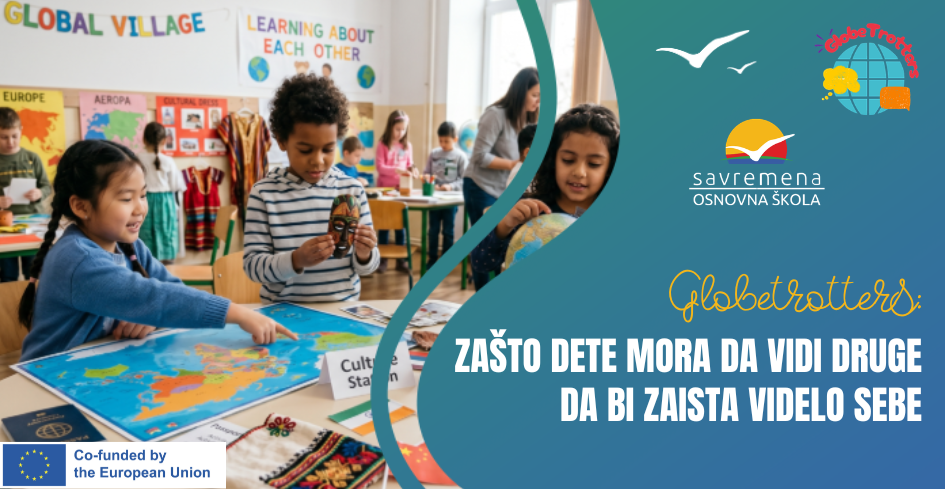
Globetrotters: The Mirror of Identity: Why a Child Must See Others to Truly See Themselves
Violeta Nincetovic / / Blog, Erasmus+ / June 3, 2026
The Mirror of Identity: Why a Child Must See Others to Truly See Themselves
We all want our children to be confident. We want them to know where they come from – their holidays, food, family stories, language. That is important. It is necessary. But there is one important truth that many parents overlook: a child cannot fully understand their own culture until they encounter someone else’s.
Think about it. A fish does not know it is in water until it jumps out of it. A child who knows only their own way of life does not realise that their way is only one possible way, not the only one. They eat their grandmother’s soup and think: “This is just soup.” They celebrate holidays and think: “This is what people do.” They do not stop to ask: “Why do we do this? What makes it special?”
However, when a child encounters another culture – when they see a child in India eating with their hands, or a child in Italy taking a two-hour lunch break, or a child in Japan bowing to a teacher – something changes. Suddenly, their own habits are no longer invisible. They begin to ask questions: “Wait, not everyone eats soup with a spoon? Not everyone celebrates birthdays with cake? Not everyone says thank you in the same way?”
Other Cultures as a Mirror of One’s Own Heritage
This is where the real superpower lies. Not in memorising facts about distant countries, but in the ability to see your own life as one beautiful possibility among many. When children grow up seeing only their own culture, two problems arise. First, they begin to believe that their way is “normal” and every other way is “strange”. This can lead to ignorance and, in some cases, prejudice. Second, they do not develop curiosity. A curious child asks: “Why do they do that?” A closed-minded child says: “That is silly.”
However, this is also where the beauty of the process lies. When you teach a child to understand others, you do not lose your own culture – you deepen it. A child who learns something about Ramadan may come home and ask: “Why do we fast on Yom Kippur? Why do we celebrate Christmas?” Then you have the opportunity to explain, to share and to say: “This is what our people do, and this is why it matters.”
Other cultures are not a threat to family traditions. They are a mirror. And it is precisely in that mirror that a child sees their own heritage clearly for the first time.
You do not have to travel the world to teach a child this. You do not need expensive books or special programmes. Small, everyday habits are enough to show: “Our way is good. Their way is good too. Let’s compare.”
Here are four simple ways to begin today:
Four Simple Ways for a Child to Discover Themselves Through Others
Talking about food
The next time you eat together, ask your child: “How do you think a child in France has dinner? What about in Ethiopia?” Look for the answer together. You may discover that children in France have dinner around 8 p.m., while in Ethiopia people eat using a soft bread called injera instead of a fork. Then ask: “Why do we use forks? Why do we eat at six?” Suddenly, the family table becomes a place for learning about your own culture.
Learning about holidays
Choose one holiday from another culture in each season. Learn one basic thing about it – not everything, just enough to understand its essence. Diwali, Lunar New Year, Hanukkah, Eid. Ask: “What does this holiday celebrate and mark? What does our similar holiday mark?” This is not about changing beliefs, but about comparison – and comparison brings a clearer understanding of both others and ourselves.
The greeting game
Teach your child how children greet one another in several different countries. In France, people kiss on the cheek; in Japan, they bow; and in some parts of Kenya, a greeting includes jumping. Then ask: “How do we greet one another? With a handshake? A hug? Why do we do it that way?” The child will understand that even a simple “hello” can say a lot about a culture.
The “not strange, just different” rule
Introduce this as a family rule. When a child says “that is strange” about something from another culture, pause and say: “It is not strange. It is just different. Let’s understand why.” Then apply the same to your own culture: “Someone else might think our customs are strange too. Let’s explain to them why we consider them important.”
Conclusion
The goal is not for a child to forget their own culture, but to love it through a broader understanding of context, once they see everything that exists around them. A child who knows only one culture does not really notice it. They simply live in it like a fish in water. A child who has encountered multiple cultures can look at their own customs, family and everyday life and say with genuine pride: “This is who we are. And I understand why it matters.”
This is not a matter of theory. This is parenting. And it works.
#GlobetrottersProject
#ErasmusPlus
#LanguageLearning
#InterculturalDialogue
#InclusiveEducation