





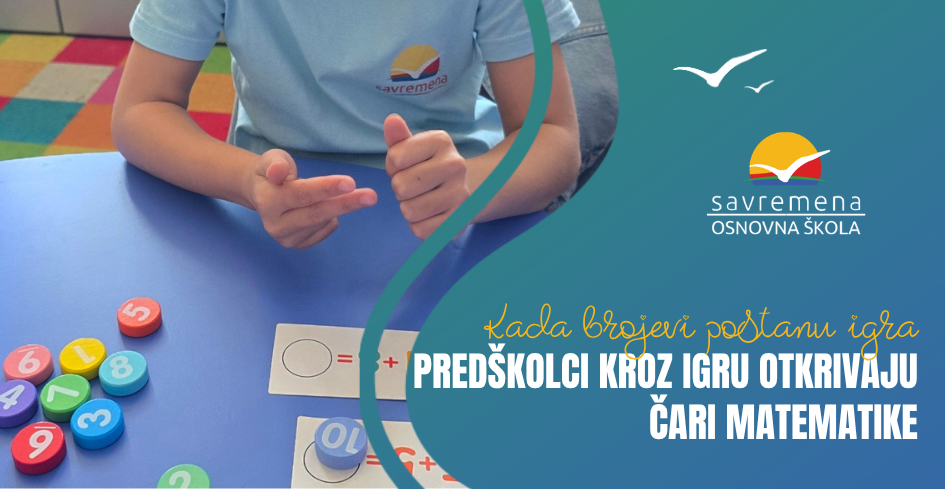
Preschoolers Discover the Magic of Math Through Play
Violeta Nincetovic / / Blog / April 15, 2026
Preschoolers Discover the Magic of Math Through Play
When numbers become a game, learning becomes joy
Mathematics in early childhood does not have to be abstract or difficult – on the contrary, it can be dynamic, engaging, and inspiring. This is exactly what our preschoolers experienced as they explored the world of numbers through thoughtfully designed activities based on play, curiosity, and collaboration.
In a warm and stimulating classroom environment, children engaged in a variety of tasks that supported the development of their early math skills. By using colorful number tokens, task cards, and interactive materials, they practiced basic operations such as addition and subtraction, as well as comparing values. Each activity became an opportunity for discovery, and every success served as motivation for further learning.
The true value of this approach lies in active learning. Children do not simply memorize information – they construct knowledge through hands-on experience. By touching, moving, and combining numbers, they develop a deeper understanding of mathematical relationships. Instead of rote learning, the focus is on thinking, reasoning, and exploring, which helps build confidence and a positive attitude toward learning from an early age.
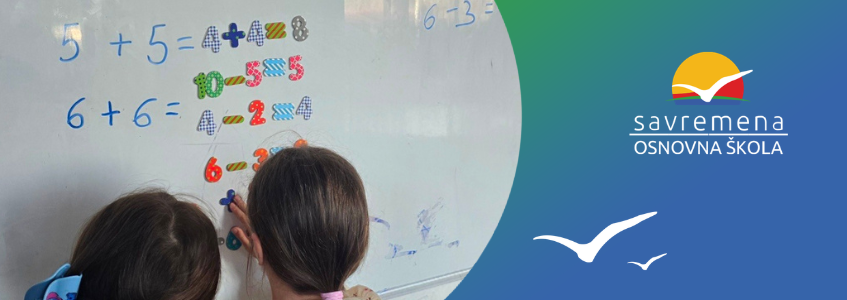
Learning through movement, collaboration, and play
During the activities, preschoolers worked both independently and in small groups, encouraging the development of social skills. Solving tasks together allowed them to exchange ideas, learn from one another, and build a sense of teamwork and belonging. In this way, math became a tool for connection, not just a subject.
The use of visual and tactile materials proved highly effective. With the help of colorful numbers and task cards, children were able to better understand relationships between quantities and numbers. Addition and subtraction were no longer abstract concepts – they became concrete actions that children could see and feel. This approach is especially important at this age, when learning is most effective through direct experience.
Working at the board further enriched the learning process. Children independently solved tasks, arranged numbers, and connected them with operations. This type of activity encourages independence, strengthens logical thinking, and allows children to recognize and correct mistakes through experimentation, without fear of failure.
Confident steps toward knowledge and self-belief
Through activities like these, our preschoolers are not only learning mathematics – they are developing lifelong skills. They learn how to think, how to solve problems, and how to collaborate with others. Every successfully completed task builds a sense of achievement and strengthens their confidence.
At this stage, the focus is not on perfection, but on the learning process. Mistakes are seen as a natural part of growth, and each child is supported to progress at their own pace. Such an environment creates a safe space where children feel free to express their ideas and develop critical thinking skills.
Once again, our preschoolers have shown that learning is most powerful when it is filled with joy and play. Through these experiences, they are not only gaining foundational math skills, but also building a strong base for future education and a lifelong love of learning.