





Mathematics in a Different Way: Students Create Their Own Clocks to Make Learning to Tell the Time Easier
Sofija Radivojevic / / October 22, 2026
Mathematics in a Different Way: Students Create Their Own Clocks to Make Learning to Tell the Time Easier
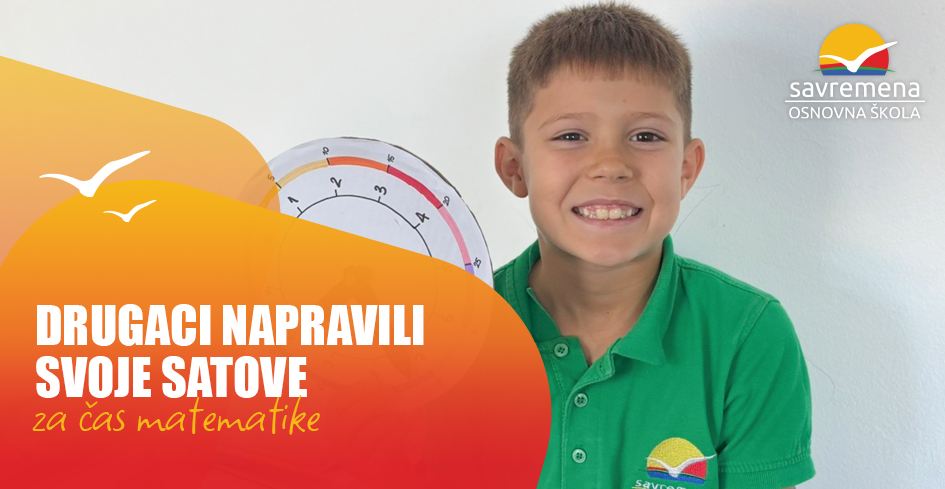
With the help of their parents, Savremena Primary School students created clocks to use during mathematics lessons and make learning to tell the time easier.
Learning to tell the time can become much more engaging when students have the opportunity to use something they have made themselves. With this in mind, second-grade students at Savremena Primary School were given a creative homework assignment: to make their own clocks with the help of their parents and use them as learning tools during mathematics lessons.
Instead of completing a traditional textbook assignment, students had the opportunity to work on a creative project at home and make clocks that would later become part of their classroom activities. In this way, preparing to learn about measuring time also became an opportunity for parents and children to spend time working together.
The clocks they created will help students better understand how to tell the time, how clock hands work and how time is represented on an analogue clock.
What makes this assignment particularly interesting is that students will be learning with materials they have created themselves. Their handmade clocks will become part of their mathematics lessons, connecting creativity, practical learning and mathematical understanding.
This approach allows children to develop new mathematical skills gradually through familiar, hands-on examples that make abstract concepts easier to understand and apply in everyday situations.

Handmade Clocks Become Part of Mathematics Lessons
Telling the time is an essential mathematical skill that children use every day. However, understanding the position of clock hands, hours and minutes can sometimes be challenging when learning is limited to explanations and textbook exercises.
That is why students were asked to create their own clocks, which will help them explore this topic in a more accessible and engaging way. With support from their parents, they prepared learning materials at home that they can use during mathematics activities at school.
Working with a clock allows students to connect mathematical concepts with familiar everyday situations. Through practical examples, they can practise recognising different times and gradually become more confident when using an analogue clock.
One of the most valuable aspects of this assignment is that students did not simply receive ready-made learning materials. Instead, they actively participated in creating them, investing their own effort and creativity into something that will support their learning.
Alongside developing mathematical skills, the assignment also encouraged cooperation between children and parents. What began as a homework task will now have a practical purpose in the classroom, where each handmade clock will become a useful learning resource.
This approach allows students to learn through personal experience and develop a clearer understanding of mathematical concepts they encounter in everyday life.
When Homework Brings School and Family Together
At Savremena Primary School, we aim to make learning meaningful through activities that encourage independence, creativity and the practical application of knowledge.
Making clocks with the help of parents is a wonderful example of how a homework assignment can serve several purposes. In addition to preparing students to learn how to tell the time, it gives them an opportunity to work together with their parents and create something they will later use at school.
When children take part in making their own learning materials, the learning process becomes more personal. A clock they have created is no longer just an object used for practising mathematics but also a result of their effort and cooperation with their parents.
Activities like these encourage students to take responsibility for their schoolwork while developing confidence through creativity and practical tasks.
At the same time, parents have an opportunity to participate in an enjoyable school assignment and support their children’s learning.
Through experiences like this, we show students that mathematics does not have to be learned exclusively from textbooks. Sometimes, making a simple clock is all it takes to turn an important lesson into something clearer, more engaging and easier to remember.
no images were found