






Globetrotters: Stop Teaching Seven-Year-Olds Grammar (They Don’t Care, and Neither Should You)
Sofija Radivojevic / / Blog / October 5, 2026
Stop Teaching Seven-Year-Olds Grammar (They Don’t Care, and Neither Should You)
Imagine two classrooms. In the first, a seven-year-old girl stares at a conjugation table as if it has personally offended her. Verb endings swim before her eyes. Technically speaking, she is “learning French”. At the same time, she is (quietly) dying of boredom.
In the second classroom, that same child stands behind a cardboard counter, wearing a little paper beret and trying to buy an imaginary croissant from her best friend, who is speaking in an exaggerated French accent. She uses “je voudrais” without knowing what a verb is, let alone what the conditional mood means. And she couldn’t care less. She just wants her croissant.
Guess which child will actually remember that phrase next Tuesday?
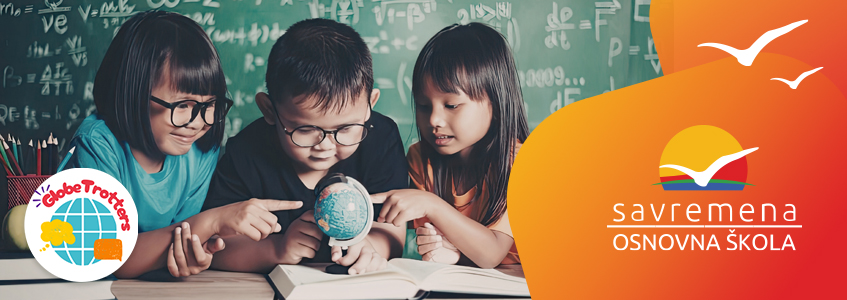
The Blank Stare Versus the Croissant
Why Grammar Tables Lose the Battle Against an Imaginary Bakery
Here is the pedagogical secret that has been hiding in plain sight all along: young children do not learn languages in the same way we teach teenagers or adults. They do not build language from rules. They acquire it through use.
1. Implicit versus explicit memory. Children under the age of 10 are exceptionally good at implicit learning – absorbing patterns through repeated, meaningful exposure to language – while they are relatively less successful at explicitly memorising rules. Asking a seven-year-old to consciously apply a grammar rule is like asking a fish to explain hydrodynamics before it swims.
2. Language is a social system, not a mathematical one. To a young child’s brain, language is not an abstract system of “if–then” rules. It is a tool for getting something that matters: attention, a croissant, a win in a game or a friend’s laughter. When you remove the social context and the real reason to communicate, you also remove the motivation for anything to truly stick in memory.
3. Anxiety kills language acquisition. Grammar exercises often come with the fear of “getting it wrong”. Fear narrows precisely those cognitive channels that need to remain wide open during language learning.
Deliberately Cheating the System
So, if grammar tables are the wrong tool, what is the right one? Play. More precisely, structured play: play with enough support and guidance for language to slip in through the back door while the child is busy having fun.
This is exactly the gap filled by the Globetrotters Language and Culture Discovery Modules. Each module turns an encounter with language into a mission: a market where you have to bargain, a mystery you have to solve, a character you have to become. Add a little role-play or some puppets, and suddenly your classroom has an entire cast of characters who “only speak” the target language. This means children have to use it to keep the story moving, not to pass a test.
The result is not simply a language that has been learned. It is a language that is lived – one fun, joyful scenario after another.
Your Move
Ready to swap the grammar table for a paper beret? Explore the Globetrotters modules with your class or download the Teacher’s Guide to see how to turn your next lesson into an adventure rather than an obligation.
References
Ellis, N. C. (2005). At the interface: Dynamic interactions of explicit and implicit language knowledge. Studies in Second Language Acquisition, 27(2), 305–352.
Council of Europe. (2020). Language education policy: Early language learning and the Common European Framework of Reference for Languages.
Nikolov, M., & Mihaljević Djigunović, J. (2011). All shades of every color: An overview of early teaching and learning of foreign languages. Annual Review of Applied Linguistics, 31, 95–119.
#GlobetrottersProject
#ErasmusPlus
#LanguageLearning
#InterculturalDialogue
#InclusiveEducation