





Globetrotters: How to Help Children Learn Languages Even If You Don’t Speak Them All
Sofija Radivojevic / / Blog / September 16, 2026
How to Help Children Learn Languages Even If You Don’t Speak Them All
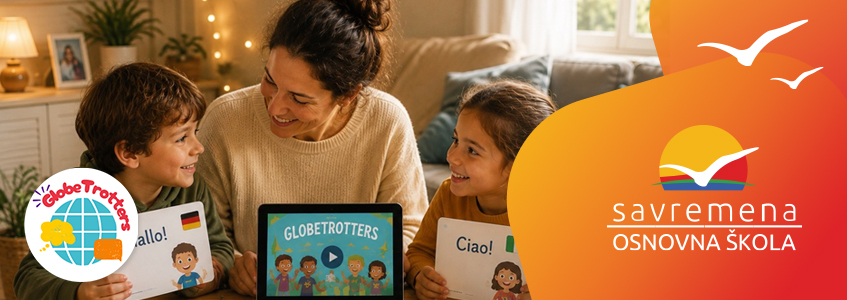
Do you need to make your child repeat a Greek word ten times for them to “remember” it? Should every car journey turn into a German vocabulary quiz? Many parents believe that supporting a child’s language learning requires discipline, repetition and almost an entire training routine. The Globetrotters project suggests exactly the opposite: children learn languages best when they are connected to play, enjoyment and the freedom to experiment, rather than the pressure to demonstrate results.
The role of a parent, therefore, is not that of a private tutor or someone who monitors progress. It is more like that of a travelling companion: someone who creates opportunities, shows curiosity and gives the child the time and space to gradually become familiar and comfortable with a language.
10 Good Ways to Offer Support Without Pressure
1. Follow your child’s pace and interests instead of imposing a predetermined programme or fixed schedule: a few well-chosen minutes are worth more than a long activity that the child experiences as an obligation.
2. Incorporate language into everyday moments – while cooking, playing or travelling – rather than turning it into a formal “lesson” at home.
3. Let your child become the teacher: ask them to teach you a word or song they discovered in class. This reversal of roles can be very empowering for a child.
4. Prioritise short, regular and enjoyable activities over long, occasional sessions: five minutes every day is better than one hour once a month.
5. Celebrate effort just as much as success: a word pronounced incorrectly but with enthusiasm deserves just as much encouragement as a correctly pronounced word.
6. Use Globetrotters project activities at home as family games – a map, an illustrated dictionary or a board game – rather than as additional homework after school.
7. Give your child opportunities to listen to songs, watch cartoons or hear stories in other languages without expecting them to understand everything: the ear develops long before complete understanding of meaning.
8. Show your own curiosity, even if you do not speak the language: a parent who says “I don’t know, let’s look it up together” gives their child permission to explore without fear of making mistakes.
9. Prioritise enjoyment and curiosity over perfect pronunciation or the number of words memorised: what matters is that the child wants to continue, not their current level of achievement.
10. Trust the long-term process: multilingualism develops over months and years, through small, repeated encounters with language, rather than through a few intensive activities.
10 Mistakes to Avoid
1. Making your child repeat a word over and over until they pronounce it “correctly”: this insistence turns a moment of discovery into an obligation and may discourage the child from speaking again.
2. Turning every outing or meal into a vocabulary quiz, risking an association between language and constant assessment rather than shared enjoyment.
3. Comparing your child with other children who are “further ahead” in language learning: every child has their own pace, and comparison is more likely to encourage anxiety than motivation.
4. Believing that you must master the language yourself to support your child: your role is to create opportunities, not to teach lessons.
5. Downplaying the importance of mistakes or punishing your child for making them, even though mistakes are an essential and necessary part of language learning.
6. Imposing Globetrotters project activities as extra homework at the end of the school day, when the child is already tired and has little energy left.
7. Giving up at the first sign of disinterest instead of simply changing the activity or choosing a different moment: finding one game boring does not mean that the child is rejecting the language.
8. Reducing learning to mini-tests or informal quizzes at home (“tell me how to say…”), thereby recreating school-related pressure outside the classroom.
9. Neglecting the cultural dimension – festivals, stories and characters from the Globetrotters journey – in favour of simply learning words, even though it is precisely this dimension that gives language meaning and makes it easier to remember.
10. Believing that it is “too late” or that your child “simply isn’t talented at languages” because they do not already speak several languages: curiosity and enjoyment are more than enough to get started, at any age.
The Globetrotters project is based on a simple belief: children learn languages in the same way they learn to walk or speak their first language – through experience, attempts, mistakes and play, never through pressure. As a parent, your greatest advantage is not your level of language proficiency, but your ability to make this journey easy, full of curiosity and something you can share together.
References
Van den Abeele, V. (2021). Apprendre les langues comme ça ? Ça change tout ! – La Méthode Tradanim. Tradanim.
#GlobetrottersProject
#ErasmusPlus
#LanguageLearning
#InterculturalDialogue
#InclusiveEducation