





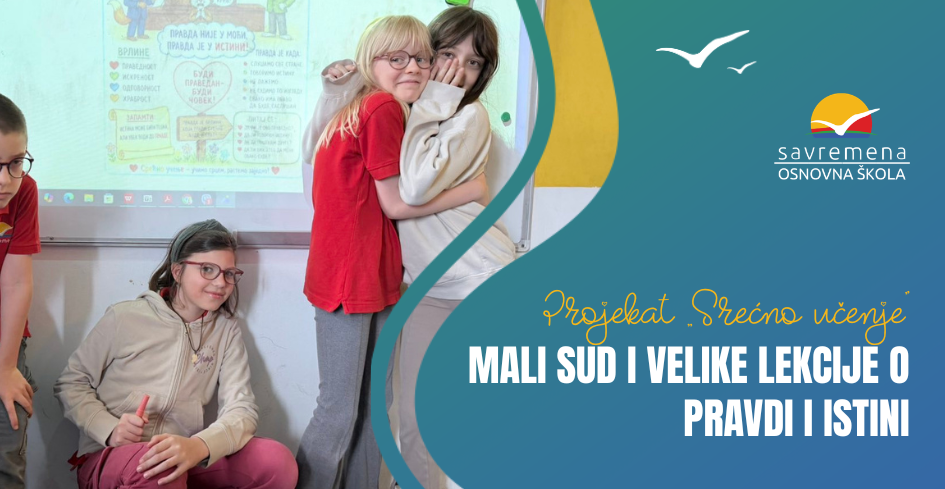
Project “Happy Learning” – A small courtroom, big lessons about justice and truth
Violeta Nincetovic / / Blog / April 6, 2026
A small courtroom, big lessons about justice and truth
Project “Happy Learning”
As part of the “Happy Learning for a Society of Values” project, third-grade students had the opportunity to explore one of the most important life values—justice—through a unique and interactive learning experience. By working on the dramatic text “The Trial” by Laza Lazić, the lesson was transformed into a dynamic and inspiring workshop where students learned through experience, play, and shared reflection.
The classroom became a small courtroom, and students enthusiastically took on different roles—judge, prosecutor, defense attorney, witness, and defendant. Through reading, discussion, and dramatization, they explored situations in which justice is not based on truth, but on power, influence, or prejudice.
This approach allowed students to gain a deeper understanding of justice and the importance of making fair and objective decisions. Learning through experience helped them recognize injustice and think about ways to overcome it.

A role that changes perspective
A particularly impactful moment came when students took on the role of the “jury” and made their own decisions. This encouraged them to listen carefully to all sides, analyze arguments, and make unbiased judgments. They realized how responsible and challenging it is to be fair, and how important it is to rely on truth.
Through collaborative work, students identified key values that form the foundation of a just society—fairness, honesty, responsibility, and courage. The discussion that followed encouraged them to reflect on their own actions and how they can contribute to a more just environment.
Teachers guided the discussion, encouraging students to express their opinions and develop critical thinking skills—one of the key goals of modern education.
Learning that shapes values
During this lesson, students did more than analyze a literary text—they developed empathy, the ability to understand different perspectives, and a strong sense of justice. Active participation helped transform knowledge into personal experience.
Together, they reached a simple yet powerful conclusion: “Justice is not in power—justice is in truth.” Moments like these highlight the importance of value-based education in shaping responsible and empathetic individuals.
Through activities like this, the “Happy Learning” project continues to support the development of well-rounded students by connecting knowledge, experience, and values into one meaningful learning process.