





When mathematics takes shape – Geometry in three dimensions

/ / Blog / January 24, 2026

When mathematics takes shape

Geometry in three dimensions

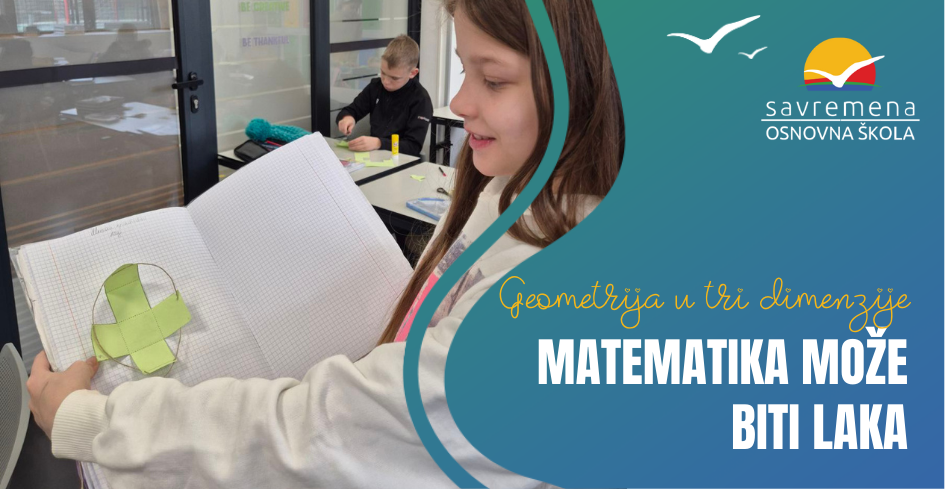
Mathematics isn’t just numbers on a board and formulas in a notebook – it’s something we can see, touch, and create with our own hands. In one of the recent math classes at Savremena Primary School, students had the opportunity to experience geometry in a completely new way. Instead of just drawing and imagining what the net of a cuboid and cube looks like, they actually made it, spread it out on the table, folded it, and transformed it into a real three-dimensional shape.

In front of them were cardboard, scissors, a ruler, and a task that sounded simple but contained a real mathematical adventure – create the net of a geometric solid and assemble it into a real 3D shape. Students carefully measured sides, drew rectangles and squares, making sure every angle was exactly ninety degrees. Every cut, every folded part was a step closer to understanding how a two-dimensional drawing becomes a three-dimensional shape. Mathematics stepped out of the textbook framework and became something they could play with, experiment with, and learn through experience.
From Paper to Space

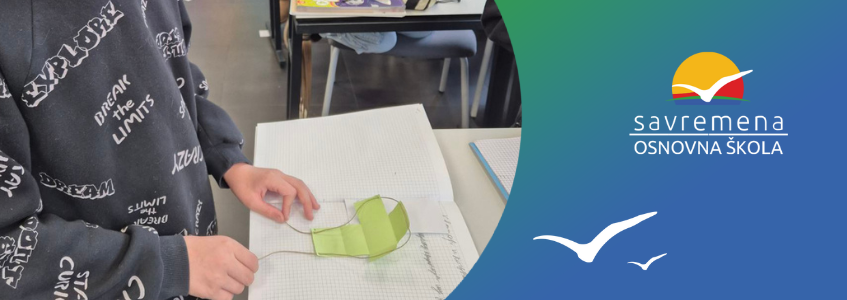
When the nets were ready, the most exciting phase began – folding and assembling. Students carefully folded edges, connected sides, and watched as flat paper slowly transformed into a cube or cuboid. Some were faster, some slower, but all were equally focused and interested. There were moments when something didn’t work as it should – an edge didn’t align, an angle wasn’t sharp enough – but that was an opportunity to understand where they went wrong and try again.

This hands-on approach enabled students to develop spatial perception, an ability that will serve them not only in mathematics but also in everyday life. Understanding how two-dimensional forms build three-dimensional objects is the foundation not only of geometry but also of architecture, design, and engineering. Through play and creativity, students learned something that will benefit them in the future – and most importantly, they learned it with smiles on their faces.

Why Hands-On Teaching Changes Everything

When students see mathematics in action, when they touch it and create something with it, it stops being abstract and intimidating. It becomes logical, interesting, and clear. At Savremena Primary School, we believe that children learn best when they are actively involved, when they can experiment and turn mistakes into lessons. That’s why our math classes aren’t just theory – they are exploration, creativity, and practical application of knowledge.

And as students proudly observe their cubes and cuboids, they know they haven’t just made a geometric shape – they’ve learned how to think spatially, how to solve problems, and how mathematics actually works in the real world. And that’s a lesson that stays forever.


Viber WhatsApp