



Art class began differently than usual. On the school screen, mosaics glowed — geometric, vivid, full of color and contrast — and the task was clear: observe, understand, then create your own. In front of each pair of students lay paper triangles in ten different colors, white sheets, scissors, and markers. And one other, perhaps more important task — to agree. Who draws the tulips? Who cuts the triangles? Which piece goes here, which goes there? Before a single piece of paper was glued down, every pair was already doing something rarely seen in a classroom — learning how to think together, in real time, without a pre-given answer. Mosaic as a technique is not a coincidence. It asks students to understand how a whole is built from fragments, how every piece plays a role, and how the arrangement of colors and shapes creates an impression that no single triangle could make on its own. Having good materials is not enough — you need to know how to put them together. And that is exactly where the real learning begins.
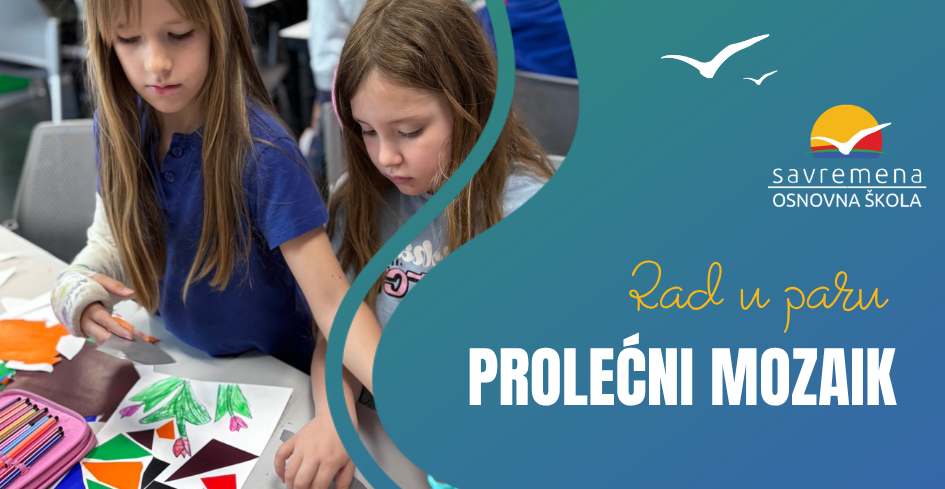
Spring Mosaic – Working in Pairs
Violeta Nincetovic / / Blog / March 26, 2026
Spring Mosaic
Working in Pairs
Every pair, their own decision
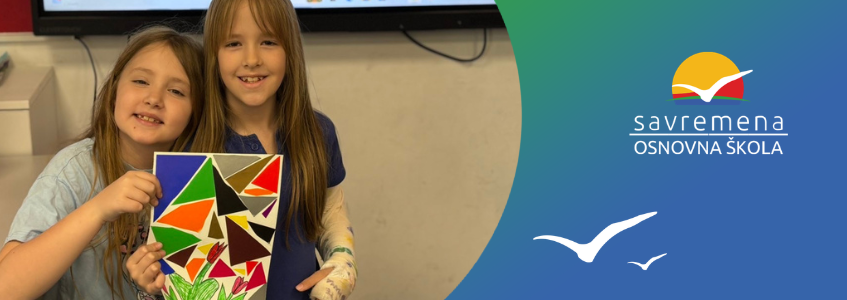
As scissors rustled and paper scraps fell across the tables, the classroom turned into a small atelier. Some students carefully drew tulips first, shading every leaf and petal, then chose triangles to frame them — dark next to light, warm next to cold, dramatic next to gentle. Others started from geometry and embedded the flower into it as if it had always belonged there. Some changed their plan three times before finding the right one. There was no single correct order. There was only what two children decided together — and that was the only right path. The finished works were different in palette, composition, and character. What united them was that specific energy of pride visible when a child completes something that is truly theirs — something in which they recognize both themselves and their partner. Two boys held up their finished work at the end and stood in front of the screen showing the inspiration, with a smile that needed no commentary. Between those two images — the reference and their own — was an entire lesson about what it means to take something you see and turn it into something of your own.
A skill that stays
The spring mosaic the students created is not just an art assignment. It reflects a way of thinking about education — one that believes children learn equally with their hands and their minds, and that collaboration is not a method but a value that needs to be built from an early age. When a child learns to ask, listen, and adapt their idea without losing it, they are not just learning art. They are learning how trust is built between two different people. They are learning how to accept someone else’s solution and how two different perspectives can lead to one better outcome. They are learning that compromise is not giving up — it is a creative decision. That skill does not have its own subject on the timetable, but it shows up in every pair that holds a finished work together and smiles. A mosaic on paper is completed in one school period. This other one — the one built into habits, character, and the way they approach shared work — lasts much longer. And that is exactly why moments like these are not just beautiful. They matter.