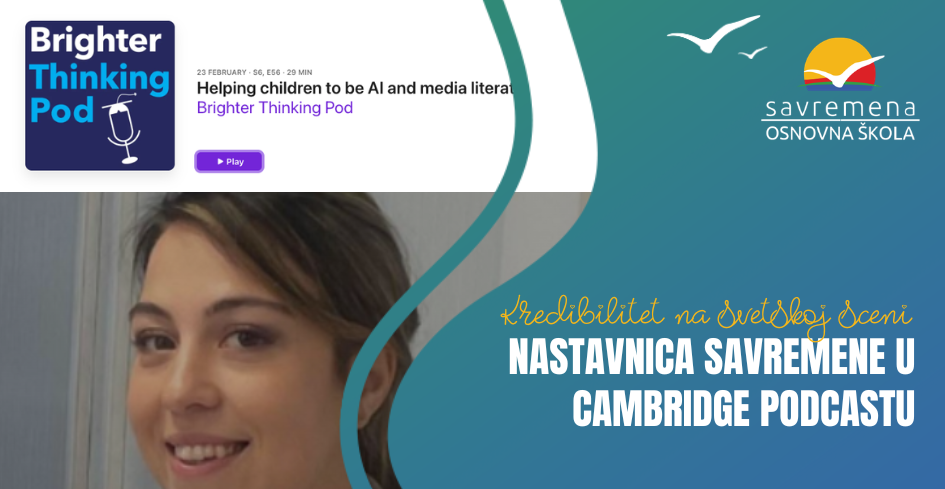
The “Brighter Thinking” podcast isn’t an ordinary show – it’s a platform where the most important educational topics are discussed with experts from around the world. Nađa spoke with Scott Thornbury, one of the leading figures in education, about changes in the Cambridge Digital Literacy curriculum. The topic was complex but extremely important: how to teach children to understand technology, critically approach information they receive online, and use AI tools in a smart and responsible way.
Because being digitally literate today doesn’t just mean knowing how to use a phone or how to make a presentation. It means understanding how algorithms work, how to recognize misinformation, how to use AI tools as support – but not as a replacement for thinking. It means being aware of what ChatGPT is, how it works, what it can and cannot do, and why it’s important to maintain critical thinking even when technology offers quick answers. And that’s what Nađa Đorđević does every day at Savremena – she teaches children not just to use technology, but to understand it.
This isn’t the first time Cambridge has recognized Savremena as a place where important things are happening. A little over a year ago, Cambridge representatives visited our school, spoke with teachers, observed classes, and left delighted. They said they saw a modern approach, dedication to each child, and understanding that education isn’t just knowledge transfer – but preparation for a rapidly changing world.
Now Nađa sits in a Cambridge podcast discussing how the Digital Literacy curriculum is changing, how AI is being integrated into teaching, and how schools should prepare children to live and work in a world where technology is no longer an option – but a reality. And while many schools are just beginning to think about these topics, Savremena is already living them. Our students learn programming, critical thinking in digital environments, and how to use AI as a tool – not as a replacement for thinking.
When Cambridge invites teachers from Serbia to speak on a global platform, it’s not just recognition of an individual – it’s recognition of the school, the methods, and the approach. It’s confirmation that what we do makes sense, that we’re on the right path, and that our children are receiving an education that’s recognized as quality not just here, but on the world stage.