





The project “Domestic and Wild Animals” brought preschoolers something a textbook alone cannot — a real experience of exploration. Through conversation, play, and shared activities, the children discovered one of the most important concepts in understanding the world around them: the difference between animals that live alongside people and those that have found their place in the forest, on the meadow, or in the wild. It was not enough to simply say “a cow is a domestic animal” — they needed to understand why, what her daily life looks like, who takes care of her, and what she gives back to the people and community she lives with. Those questions did not go unanswered. The children asked them, thought about them, discussed them, and reached conclusions in a way that was entirely their own. Every child brought something personal to the conversation — someone’s memory of their grandmother’s village, someone’s recollection of the zoo, someone’s curiosity that simply could not wait for the next class. And it was precisely that diversity of experiences and starting points that turned this project into something more than a themed lesson — it created a shared space where all knowledge was welcome and every contribution had value.
Preschoolers Explore – A Project on Animals
Violeta Nincetovic / / Blog / March 30, 2026
A Project on Animals
Preschoolers Explore
A happy farm in the hands of preschoolers
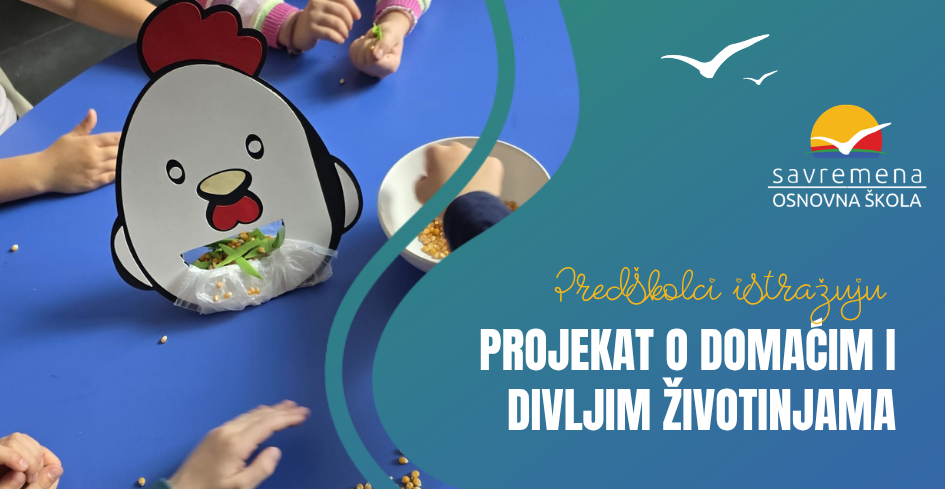
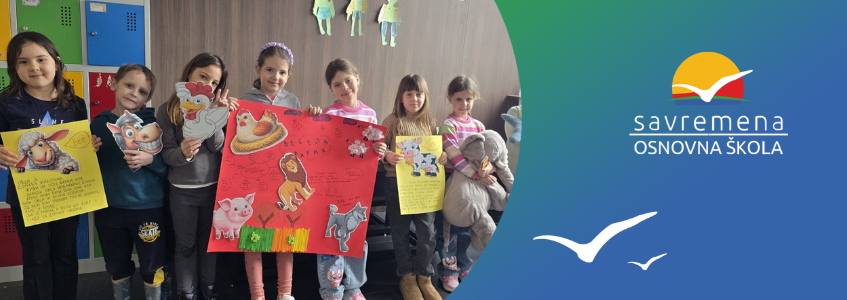
The activities that followed were full of energy, color, and focus. In groups, the children drew animals on large green sheets of paper, carefully choosing details — who has horns, who has wings, who lives in a pen and who in a cage. They made posters titled “Happy Farm” — vivid, full of cut-out and drawn animals, with texts they dictated or wrote themselves. The posters featured sheep, cows, horses, chickens, and pigs, but also lions and elephants — with a clear distinction drawn between those who live with people and those who are free in nature. One of the most popular activities was making a pig from pink paper that served as a feeder — the children filled it with corn kernels and green leaves, imitating the care given to animals on a farm. That game was not just fun. It was a concrete, tangible illustration of what they had learned — that domestic animals depend on people, and that this responsibility means daily attention, time, and care that cannot be postponed until tomorrow.
What we take from this project
At the end of the project, when the children stood in a row and proudly held up their work, their faces showed something more than satisfaction over a beautiful poster. What showed was ownership of knowledge — that particular expression when a child feels they understand something they did not understand before, and that this understanding came through them, not just to them. The project “Domestic and Wild Animals” was not just a topic — it was a way for children to encounter the concepts of responsibility, nature, and community at a level that is close and comprehensible to them. They learned that every animal has its place in the world, that some of them live alongside us and that we owe them care, and that this care is something beautiful and important. When education manages to bring a child to such a conclusion — through play, conversation, their own hands, and shared work — it has done the most important thing it can. It has left a mark that stays long after the poster comes down from the wall.