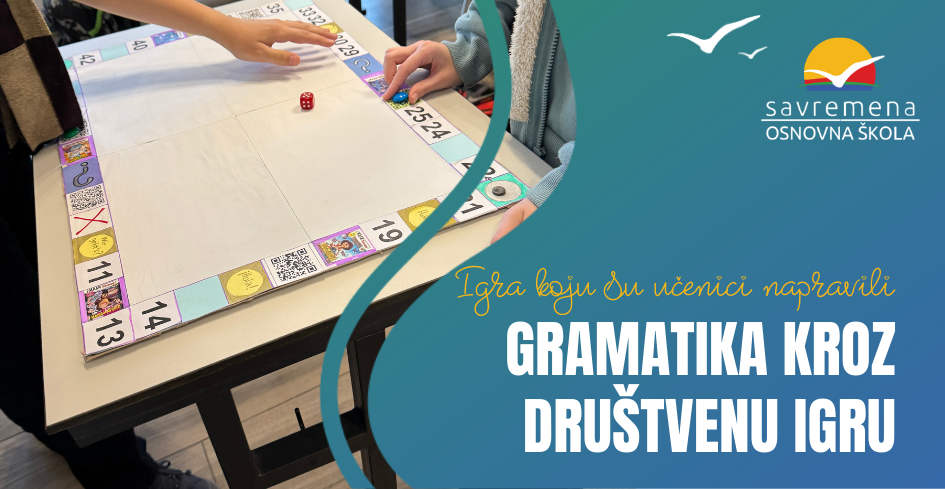
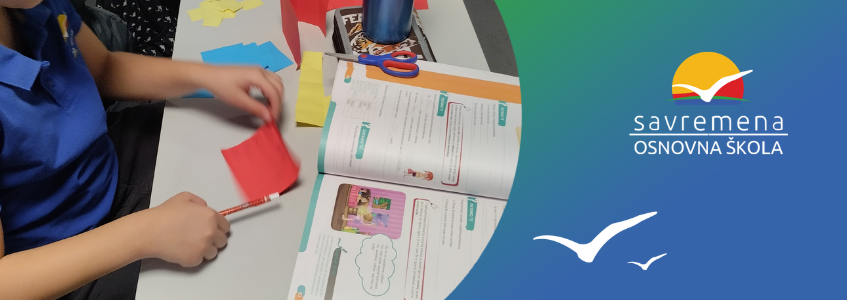
The game wasn’t just rolling dice and moving pieces. Students were divided into teams. Each team had tasks – individual and group. Some tasks were in the form of QR codes they scanned with phones. Some were in “Mali Zabavnik” – a magazine they used as additional literature. Some were textual – reading passages and identifying grammatical categories.
Each team had its own strategy. Some chose easier tasks to collect points quickly. Some went for harder tasks because they brought more points. Some agreed on who would solve what, who was best at nouns, who at pronouns. And even students who weren’t directly participating in the game – didn’t sit passively. They followed what other teams were doing. Scored answers. Checked accuracy. Were part of the process. This wasn’t passive teaching. This was an activity where everyone had a role. And everyone learned – either through playing, through observing, or through evaluating.
Grammar is often perceived as boring. Rules. Tables. Declensions. Conjugations. Something learned by heart and forgotten as soon as the test passes. But when grammar becomes part of a game – the perspective changes. Students don’t learn rules because they have to. They learn them because they need them to solve a task, win points, win the game. And when they participate in making the game themselves – they understand it on another level. They know why a question is posed exactly that way. They know what the challenge was. They know how the game is won.
Marina Gavi didn’t just design a game. She created an activity where students take responsibility for their learning process. Where they collaborate. Where they apply knowledge functionally. Where grammar isn’t the goal – it’s a tool. Grading was aligned with student engagement and achievement. Tasks were adapted to all levels. And everyone had a chance to contribute – regardless of how well they know grammar. This wasn’t just a Serbian language class. This was an example of how learning through games can be just as serious as traditional teaching – but much more effective. And more fun. Because when students help make a game and then play it – they don’t just learn grammar. They learn how knowledge is used. And that’s a lesson that stays.