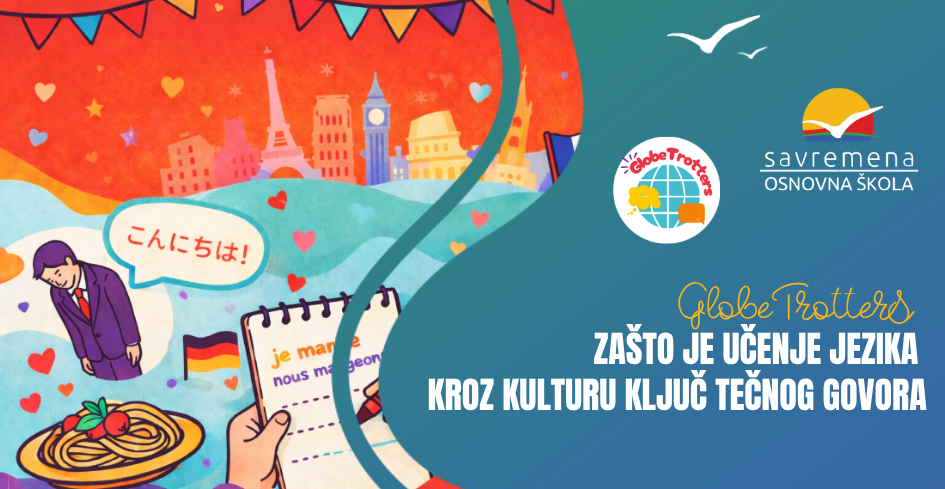
The cultural approach helps us immerse ourselves more deeply in the language. Memorizing a list of words related to food can be tedious. But watching a vivid Italian film in which a family passionately argues about a recipe for ragù transforms words like aglio (garlic), pomodoro (tomato), and amore (love) into a rich sensory experience. These words are no longer abstract, but are connected with the clatter of pots, the warmth of the kitchen, and the emotion of a shared meal. You don’t just learn the word for “bread” (pain in French); you also learn about the traditional, daily habit of going for a fresh baguette at the boulangerie (bakery). This emotional and narrative connection creates neural pathways that are far more lasting than those built by simple repetition alone.
Furthermore, culture unlocks the humor and personality of a language. Humor is often the last step for a language learner, as it is deeply rooted in cultural nuances, wordplay, and shared context. The dry, self-ironic spirit of British comedy, the absurd sketches on Japanese television, and the quick, ambiguous comments of the Argentine variant of Spanish are impossible to fully understand without knowing the cultural ground from which they emerged. By immersing ourselves in music, films, and comedy, we stop trying to grammatically “solve” a particular linguistic expression and begin to truly feel the language. We learn the rhythm, melody, and unwritten rules that shape playful exchanges of words.
The advantages of this approach lie in moving toward deeper empathy and intercultural competence. Language is a lens through which a culture views the world. The existence of multiple words for “love” in Greek (agape, eros, philia, storge) or complex terms for different types of rain and light in Japanese reveals what a society considers important enough to name with precision. By learning these concepts, we don’t just expand our vocabulary, but adopt a new way of observing and classifying human experience. We begin to understand the collective values embedded in the unique Danish concept of hygge, which denotes a special feeling of comfortable, warm coziness. This process breaks down ethnocentric barriers and enables a more subtle, more tolerant view of the world.
So how do we apply an approach to learning that puts culture first? Modern students have an inexhaustible source of possibilities at their fingertips.
Consume authentic media: Forget sterile dialogues from textbooks. Watch contemporary films and series with subtitles in the target language. Listen to popular music and read song lyrics. Follow influencers from the country whose language you’re learning. This reveals contemporary slang, natural speech rhythm, and topics that are truly relevant to native speakers.
How to Apply This Approach
Connect with art and history: Read folk tales, fairy tales, poetry, short stories. Explore the country’s history. Understanding key historical moments (revolutions, hardships, victories) provides essential context for idioms, national character, and even political discourse.
Connect with people: Use language exchange apps not as a grammar exercise, but as a cultural exchange. Ask your conversation partner about traditions, favorite holidays, family customs, and what makes them laugh. Food is a universal bridge, so learn to prepare a traditional dish and the vocabulary that accompanies it.
Reshape your goals: Instead of having the goal “master the subjunctive,” set the goal: “understand jokes in my favorite Spanish series” or “be able to follow a recipe in French.”
This, of course, doesn’t mean that grammar isn’t important. It is the necessary skeleton that gives language structure. But without the “blood and flesh” of culture, that skeleton is immobile. It cannot dance, sing, or tell a story. It cannot create friendship or fall in love.
True fluency is not the absence of grammatical errors, but rather the ability to move through the invisible currents of meaning that flow beneath words. It is the confidence to step outside the textbook, into the living, complex, and beautiful reality of human connection. When we embrace culture as our main textbook, we stop being language students and become participants in a world.
International Partnership
Savremena Primary School has become a partner in the GlobeTrotters project – an international educational project funded by the European Union. The project brings together schools and educational institutions from different European countries with a common goal: to advance foreign language learning through an innovative approach that places culture at the center of the teaching process. The partnership enables the exchange of experiences, joint activities, and access to resources that support modern methods of language teaching.
Through partnership in the GlobeTrotters project, Savremena Primary School contributes to the development of educational programs that do not view language only as a set of grammatical rules, but as a living system that develops through culture, history, and everyday communication. The project is funded by the European Union and brings together a team of experts dedicated to improving the quality of education in the field of foreign language learning.