



Contemporary education increasingly demands approaches that surpass traditional, linear models of language learning and respond to the needs of digitally oriented and visually sensitive generations of students. In this context, comics stand out as an effective didactic tool that integrates verbal and visual elements into a coherent narrative whole. As a multimodal type of text, comics enable students to acquire language through context, narration, and interaction, stimulating motivation, comprehension, and communicative competence.
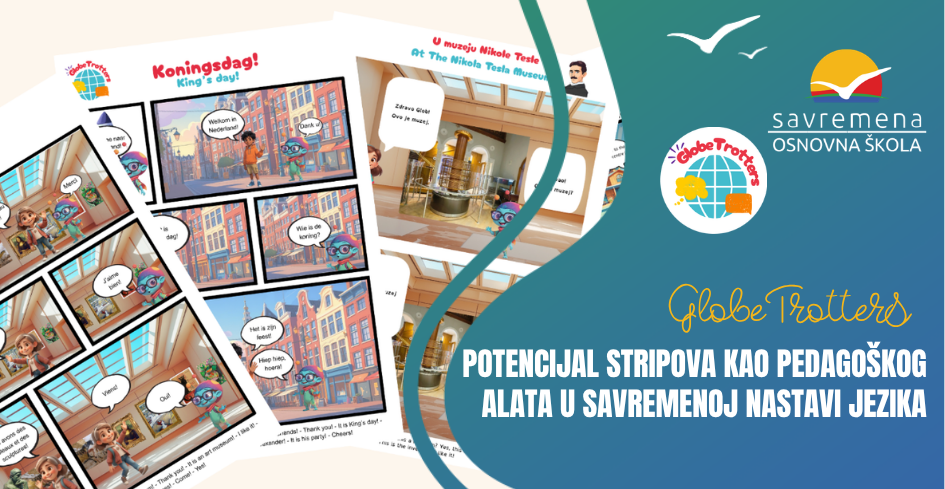
GlobeTrotters – The Multimodal Potential of Comics as a Pedagogical Tool in Contemporary Language Teaching
Violeta Nincetovic / / Blog / March 1, 2026
The Multimodal Potential of Comics as a Pedagogical Tool in Contemporary Language Teaching
GlobeTrotters
Comics as a Multimodal Pedagogical Resource
Comics represent a specific form of multimodal discourse in which meaning is built through the interaction of images, written text, frame arrangement, and narrative flow. This structure enables students to simultaneously process information through multiple channels. Visual support in comics reduces cognitive load and enables understanding of meaning even when students’ linguistic competence is not yet fully developed. Instead of acquiring isolated words or grammatical forms, students actively construct meaning by connecting visual signals with textual information.
Research consistently indicates that comics have a positive impact on student motivation and their emotional engagement in the language learning process. Comics are perceived as accessible and entertaining, which reduces anxiety associated with language use and encourages students to participate more actively in communication. Especially with younger students, the narrative structure and recognizable characters promote emotional involvement and identification, making the language learning process more meaningful and motivating.
One of the key advantages of comics in language learning is the possibility for new vocabulary to be presented in context. Words appear in dialogues and situations that illustrations support, enabling students to infer meaning without explicit explanations or translations. Empirical research shows that reading comics leads to significant incidental word learning, as visual elements in comics enable students to infer the meaning of new words and expressions based on context and remember them longer.
Examples of Classroom Activities Based on Comics:
In addition to receptive skills, comics have great potential for productive use of language. Creating comics encourages students to actively use language through designing characters, dialogues, and story development. Research shows that the use of comics in language teaching stimulates creative expression and analytical thinking, as students actively build meaning through verbal and visual modes.
Within the Globetrotters project, students are introduced to child character-guides from different countries, as well as alien characters who travel through various European countries exploring their languages and cultures. Many Globetrotters packages with physical activities contain comics ready for printing. In addition, Globetrotters mini-games have a visual design in comic style, both in printed materials for physical activities and on the digital platform, which provides a connected and stimulating learning experience.
Activity: Three-Panel Comic – Students create a three-panel comic that represents, for example, My Day – morning, school, and afternoon, adding one simple sentence to each panel. Students can draw their own comic or use printed frames into which they paste cut-out images from old magazines or catalogs to create content.
When working on project themes, students can use characters that were previously introduced in modules to create their own comics. Within the Globetrotters project, students can choose the characters they like most, print and cut them out, then arrange them in a pre-prepared comic template. The comic can consist of three to four panels, organized around a topic of the students’ choice.
The integration of comics and simple digital tools for creating comics in foreign language teaching supports multimodal learning, reduces cognitive load, and encourages meaningful vocabulary acquisition through contextualized language use. At the same time, it stimulates student motivation, creative expression, and intercultural awareness, making this approach particularly suitable for innovative educational practices and international projects.
International Partnership
Savremena Primary School has become a partner in the Globetrotters project – an international educational project funded by the European Union. The project brings together schools and educational institutions from different European countries with a common goal: to advance foreign language learning through an innovative approach that places culture at the center of the teaching process. The partnership enables the exchange of experiences, joint activities, and access to resources that support modern methods of language teaching.
Through partnership in the Globetrotters project, Savremena Primary School contributes to the development of educational programs that do not view language only as a set of grammatical rules, but as a living system that develops through culture, history, and everyday communication. The project is funded by the European Union and brings together a team of experts dedicated to improving the quality of education in the field of foreign language learning.