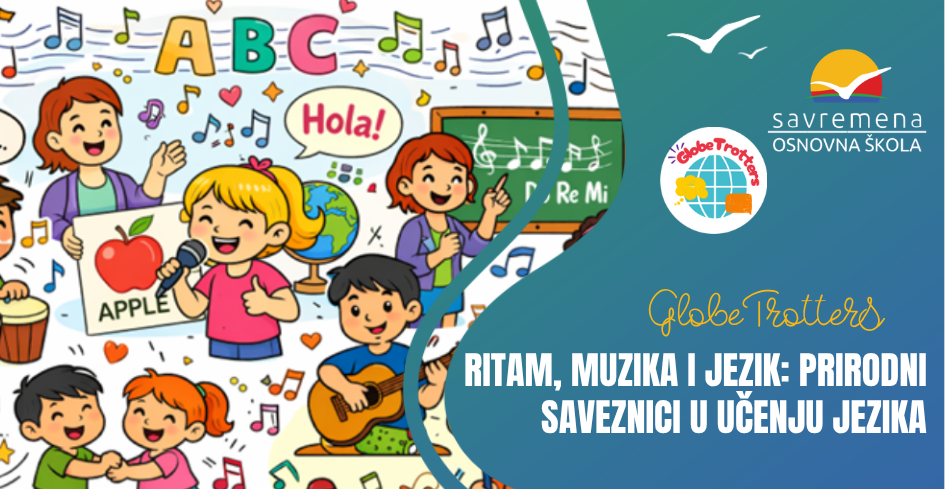
Music and language are processed in the brain in similar ways. Both are based on auditory patterns, rhythm, and structure. Neuroscientific research shows that when listening to music or speech, common brain areas are activated. This means that music is not something “separate” from language; on the contrary, it can stimulate the development of language abilities.
Research shows that students who attend additional music classes achieve better results in reading and writing compared to peers without musical education. Children who are musically educated show better understanding of syntax and grammar, as their brains respond more efficiently and reduce language errors – whether they occur in a sentence or in a musical phrase. This opens up important possibilities for pedagogy: music can be used as a means to improve language, especially in children who have difficulties in reading, writing, or understanding speech. Music acts as a “bridge” for memory. Melodies and repeating rhythms help children remember words and phrases more easily. That’s why songs are extremely useful in learning vocabulary – texts are imprinted in memory faster and in a pleasant way.
Phonological awareness – the ability to recognize, distinguish, and manipulate the sounds of language – develops significantly through musical education. Research shows that children who participate in musical activities achieve better results in reading and writing. Simple examples are rhyming nursery rhymes and sound games, which can easily be incorporated into everyday language teaching.
For teachers, this means that music can be a tool that enriches teaching, rather than replacing traditional methods. Combining music and language makes learning more natural, pleasant, and efficient. Music has a strong emotional impact. It creates a positive atmosphere, reduces stress, and encourages active participation of children. In language teaching, this is of exceptional importance: students who feel relaxed and satisfied learn faster and show greater self-confidence. Using songs and musical games also encourages empathy and cooperation among students, which improves socialization. When children learn together through music, they develop communication and collaborative skills that are crucial for language development.
Music and language are not separate phenomena – they are deeply connected. Music can improve memory and vocabulary, enhance phonological awareness and pronunciation, stimulate motivation for learning, improve social skills, reduce stress and increase active participation of all children, support language learning in children with special needs, and develop interest in other cultures.
Teachers can incorporate musical activities into their teaching by relying on children’s natural curiosity and joy in musical creation. In this way, music becomes a valuable pedagogical tool that makes language learning more natural, pleasant, and effective.
International Partnership
Savremena Primary School has become a partner in the Globetrotters project – an international educational project funded by the European Union. The project brings together schools and educational institutions from different European countries with a common goal: to advance foreign language learning through an innovative approach that places culture at the center of the teaching process. The partnership enables the exchange of experiences, joint activities, and access to resources that support modern methods of language teaching.
Through partnership in the Globetrotters project, Savremena Primary School contributes to the development of educational programs that do not view language only as a set of grammatical rules, but as a living system that develops through culture, history, and everyday communication. The project is funded by the European Union and brings together a team of experts dedicated to improving the quality of education in the field of foreign language learning.