



As a consequence of migration, globalization, and increasing mobility, contemporary societies are characterized by growing cultural and linguistic diversity (Lohe & Elsner, 2014: 29). This environment has imposed the need for introducing new didactic approaches that simultaneously respect students’ linguistic and cultural repertoires and prepare them for life in a global world. Language Awareness has been recognized as an adequate approach for achieving this goal, as it provides students with the opportunity to explore linguistic and cultural diversity and develop the knowledge, skills, and attitudes necessary for “living together” (Lourenço, Andrade & Sá, 2017: 2).
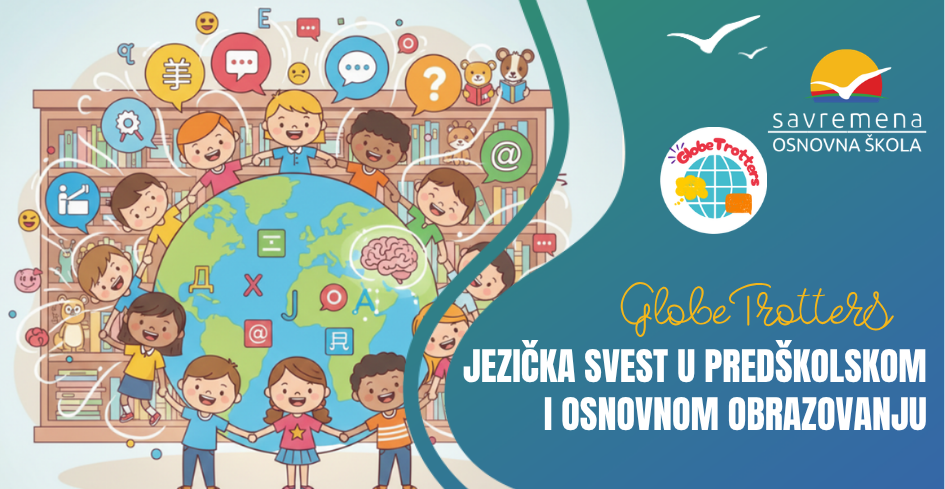
GlobeTrotters – Language Awareness in Preschool and Primary Education – The Seed of Lifelong Learning
Violeta Nincetovic / / Blog / February 2, 2026
Language Awareness in Preschool and Primary Education - The Seed of Lifelong Learning
GlobeTrotters
Why are Preschool and Early School Age Particularly Important?
The period of preschool and early school education represents a “golden window” for the development of language awareness for several reasons:
Cognitive flexibility: At this age, the brain is exceptionally plastic. Exposure to the “mechanisms” of different languages contributes to the development of metalinguistic awareness – the ability to think about language as an object. Research shows that students with developed language awareness often achieve better results in other subjects as well, including mathematics and logic, because they are accustomed to recognizing hidden patterns.
Strengthening literacy in the mother tongue: Although it may seem surprising, getting to know other languages helps children better understand their own. When students learn, for example, that French uses gender-marked nouns or that Japanese has multiple writing systems with different functions, they become more sensitive to the nuances of their own grammar and spelling. Thus, literacy shifts from mechanical memorization to active exploration.
Encouraging social inclusion: In a diverse classroom, language awareness values the mother tongues of all students. When a teacher highlights a word in Arabic or Polish, the mother tongue of a bilingual student ceases to be a potential obstacle and becomes a resource for the entire class. In this way, a culture of respect is built and linguistic anxiety is reduced.
How Can Teachers Encourage Language Awareness?
Teachers do not need to be polyglots to develop language awareness in the classroom. It is sufficient to:
- create a linguistically stimulating environment through diverse texts, multilingual displays, and oral storytelling;
- encourage metalinguistic conversations and guide children to think about words, grammar, and meaning;
- celebrate linguistic diversity by inviting students to share words or expressions from their family, mother tongues;
- integrate language activities into different subjects, connecting language with science, history, or art.
Some simple and interesting activities for introducing language awareness into teaching are:
“Language Detective”: Students are given a short text in an unknown but related language (e.g., Italian if they know some Spanish) and asked to “discover” the meaning with the help of context and similar words.
Hunting for Loanwords: Exploring the origin of everyday words. Learning that “shampoo” comes from Hindi or “robot” from Czech helps children experience language as a living history book.
Sound Comparison: Listening to audio recordings of different languages and discussing their “melody” and “rhythm,” which contributes to the development of phonological sensitivity.
Language Awareness as a Lifelong “Ally”
The goals of language awareness programs should be clearly explained to parents and teachers, emphasizing that language learning should not be equated with learning about language and the cultures that are inseparably connected with it (Young & Helot, 2003: 239). When we teach children about language, we are not only teaching them to speak, but also to listen, analyze, and connect. As they grow, this awareness becomes a powerful “ally” that helps them navigate complex texts, conduct dialogue with respect, and adapt to a globalized world in which multilingual communication is crucial.
The goal of language awareness is not immediate fluency in speaking a language, but creating confident “language explorers” (Barton, Bragg & Serratrice, 2009: 149). By removing the fear of the “foreign” and replacing it with a sense of curiosity, we give children tools for navigating a multilingual world and sow the seed of lifelong curiosity, empathy, and analytical thinking. That is precisely the essence of our Globetrotters project, isn’t it?
International Partnership
Savremena Primary School has become a partner in the Globetrotters project – an international educational project funded by the European Union. The project brings together schools and educational institutions from different European countries with a common goal: to advance foreign language learning through an innovative approach that places culture at the center of the teaching process. The partnership enables the exchange of experiences, joint activities, and access to resources that support modern methods of language teaching.
Through partnership in the Globetrotters project, Savremena Primary School contributes to the development of educational programs that do not view language only as a set of grammatical rules, but as a living system that develops through culture, history, and everyday communication. The project is funded by the European Union and brings together a team of experts dedicated to improving the quality of education in the field of foreign language learning.