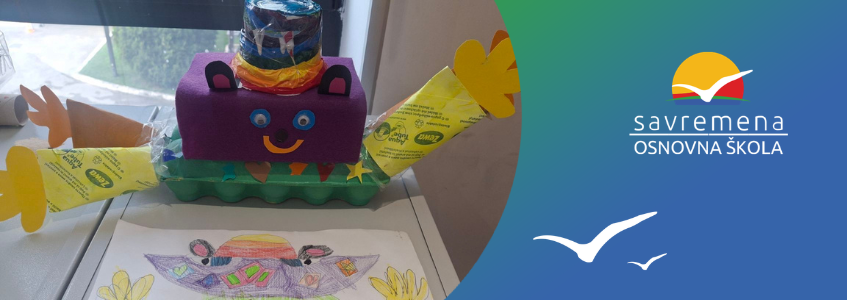
This is where the science of materials came in. Children learned that every material has its own characteristics — cardboard is light but stable; plastic bottles are flexible and durable; caps are perfect for details; fabric brings texture and warmth; toothpicks and straws can create constructions that look complex but are actually very simple. Through experimentation and mistakes, they discovered which combination of materials best serves their purpose. Some learned that it’s better to use multiple layers of cardboard for stability, while others discovered that plastic lids can be perfect wheels or eyes.
This process wasn’t just technical practice. It was an act of problem-solving. How do you make a figure stand? How do you connect two different materials? How do you achieve making the toy look the way you imagined it? Each student faced their own unique challenges, and each found their own solution. Through this process, they developed critical thinking, spatial intelligence, and perseverance — skills that transcend the classroom and will follow them throughout life.
And this wasn’t just a lesson about the physical properties of materials. It was also a lesson about how things get a second chance. Instead of ending up in the trash, old boxes, lids, bottles, and paper became parts of something completely new. Children understood that recycling isn’t just separating waste — it’s creativity, it’s finding value where others see garbage. It’s a way of thinking that transforms our relationship with the things we own and with the planet we live on.
A Project That Combines Imagination and Responsibility
This project wasn’t just about making toys. It was about how we think about the world around us. How every material has its own story and purpose. How our imagination can transform what would otherwise be discarded into something meaningful, beautiful, and functional. And how we, as individuals, can make small decisions that together make a big difference for our planet.
When students realize they can create something useful and beautiful from what others would throw away, they learn a fundamental lesson about value. Not about monetary value, but about the value of resources, effort, and creative thinking. They learn that they don’t always need to buy new when they can transform old into something new. They learn that our planet is full of resources that deserve a second chance. And they learn that they are the ones who can make a change.
When students finally held their toys in their hands, they saw more than recycled material. They saw proof that ideas aren’t just abstract thoughts, but something that can be created. They saw that they are capable of turning the imagined into the tangible. They saw that the creation process — from idea through drawing to final toy — isn’t linear, but full of trials and errors, adjustments and improvements. And they learned that the most important toy may be precisely the one you make yourself — because in it lives your creativity, your effort, and your responsibility toward the world we live in.
At Savremena, we don’t just teach children to know. We teach them to create, to innovate, and to care. Because true education isn’t just knowledge — it’s the ability to use that knowledge in a way that makes the world a better place. One recycled toy at a time. One student at a time. One idea at a time.