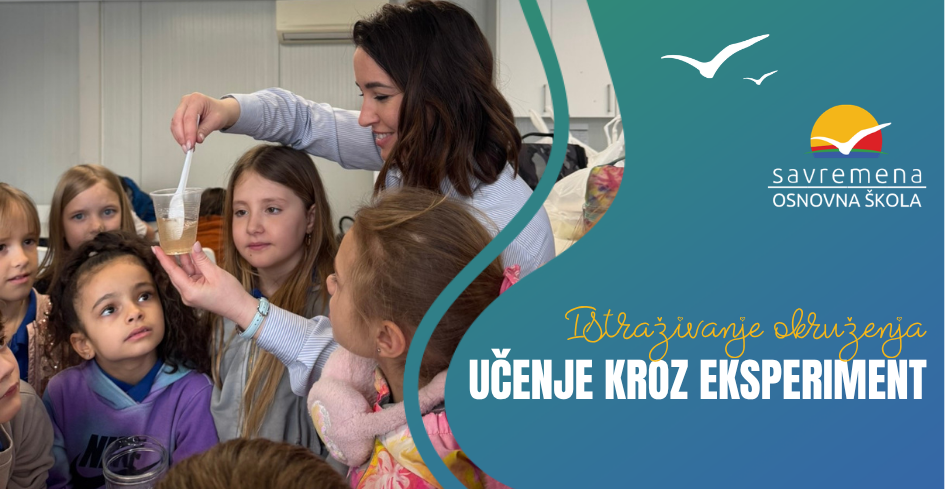
The central part of the lesson focused on experimenting and discovering how different substances react when in contact with water. Students mixed ingredients, observed changes, and compared results, developing basic scientific skills such as observation, reasoning, and classification. Particular interest was sparked by comparing materials that dissolve completely with those that remain visible or separate, such as oil.
Through these activities, students not only understood fundamental scientific concepts but also developed patience and precision in their work. Each step of the experiment became an opportunity to ask new questions: Why does something dissolve? What happens when we mix different liquids? Can we predict the outcome? These questions form the foundation of scientific thinking and encourage students to explore further.
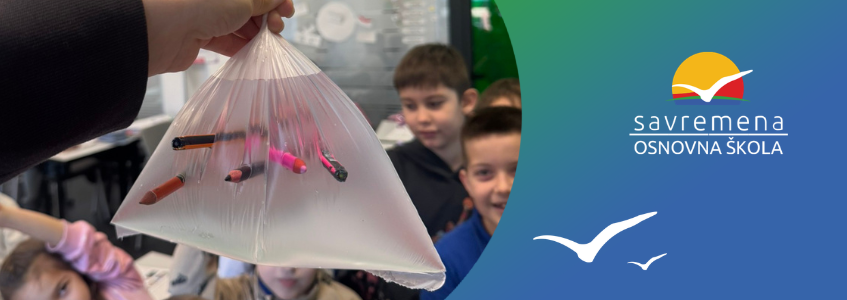
A highlight of the lesson was the experiment with water and pencils, which added an extra layer of excitement. This unusual and visually engaging activity demonstrated how water interacts with different materials, sparking enthusiasm and motivation. Through play and exploration, students reinforced their knowledge and connected theory with practice.
Learning That Lasts: Knowledge Through Experience
Lessons like this clearly show that the most meaningful learning happens when students experience the content firsthand. At Savremena Primary School, we believe that experiential learning is key to developing functional knowledge, as it enables students to truly understand, rather than simply memorise information. Through experiments, students develop logical thinking, independence, and confidence in expressing their ideas.
In addition to gaining knowledge in the field of natural sciences, such activities also support the development of social skills. Students worked together, exchanged ideas, and helped one another, learning how to collaborate and communicate effectively as a team. The atmosphere in the classroom was filled with curiosity, laughter, and excitement, highlighting the importance of making learning inspiring and engaging.
The combination of play, exploration, and hands-on work made this lesson a truly memorable experience. These are the moments that shape a positive attitude towards learning and inspire children to develop a lifelong love of knowledge. Savremena Primary School continues to provide opportunities that inspire, motivate, and support the holistic development of its students – because true education is not only what we learn, but what we remember through experience.