





At Savremena Primary School, the lower-grade classroom has been transforming for weeks into a tiny theatre world—one where everything begins with a simple question: “How would your character tell this story?”
During the drama and recitation club, our young performers are taking their first acting steps while preparing a play that blends creativity, playfulness and genuine childhood joy.
Unlike typical drama rehearsals, our little actors start from the very beginning—by creating the characters they will perform. With scissors, cardboard, markers and loads of imagination, a colourful parade of animals came to life: giraffes, cats, birds, horses, dragons and completely invented creatures whose personalities shine the moment you look at them.
Children chose the colours, drew eyes, added details, invented names and explained proudly: “This is my character—he has a special superpower!”
Making the puppets is not just a creative task—it is the first step in understanding the character, their emotions and the role they will bring to life on stage. Through this process, children learn how to turn an idea into something real, how to work patiently and carefully, and how to respect the work of their friends.
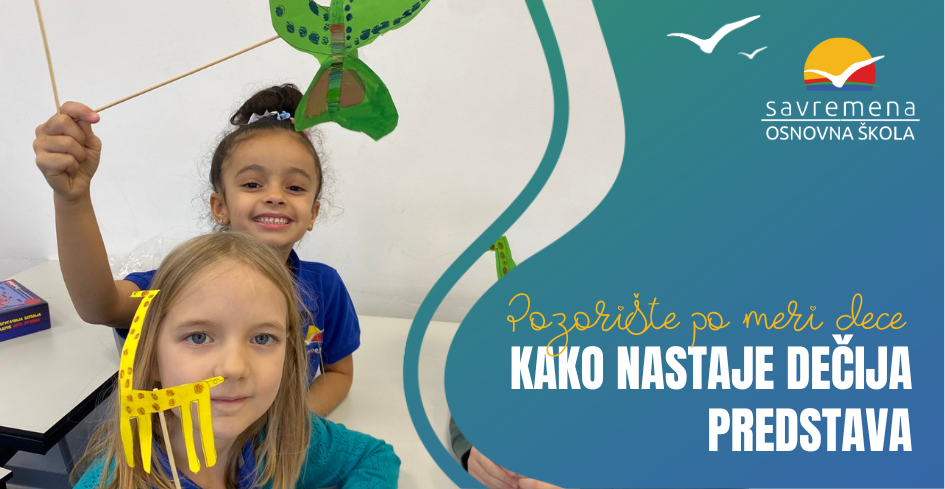
Children’s Theatre, their way – How a kids’ performance comes to life
Violeta Nincetovic / / Blog / November 26, 2025
Children’s Theatre, their way - How a kids’ performance comes to life
Imagination on Stage: How Children Build Their Own Theatre

Rehearsals That Look Like Real Theatre Practice
Once all the characters found their shape, the next exciting phase began—acting rehearsals.
The desks became a stage, the space behind them turned into a “backstage”, and the classroom transformed into a lively little theatre filled with movement, whispers and laughter.
Students practiced voice projection, diction, tempo, and—most importantly—listening to one another. In small groups, they tried out dialogue they created themselves, explored how their characters move, and experimented with how they sound when they’re happy, angry, surprised or sad.
Some students naturally stepped into the role of narrators, others became the stars of the funniest lines, while a few turned into “set designers” who suggested how the space could transform into a stage.
What made the process especially beautiful was the atmosphere of support the children created on their own. You could hear:
✨ “Do you want me to hold your puppet while you talk?”
✨ “My character can talk to yours—let’s think of something together!”
✨ “You say the first line, I’ll go next.”
Through these simple moments, they learn teamwork, empathy, self-control and improvisation. Even mistakes become part of the fun—when someone forgets a line, the whole group jumps in to help, creating a safe environment where everyone belongs to one story and one team.
The Power of Drama: Confidence, Expression and Emotional Growth
The drama and recitation club has a purpose much bigger than the play itself. It is a space where children develop the confidence to stand in front of others, speak loudly and clearly, express emotions and convey a message.
Through the preparation process, they naturally strengthen concentration, verbal expression, empathy and creative problem solving—skills that matter whether they grow up to be actors, scientists, architects or anything in between.
They learn to listen, to wait for their turn, to respect the agreed-upon roles, and to understand what it means to be part of a group in which every character, every gesture and every voice matters.
For many of them, this is the first time they experience performing before an audience—even if that audience is just their class for now. And that experience builds courage—the kind of courage that lasts long after the stage lights turn off.
The play is still in the making, but it’s already clear that it will be special—not because of the storyline itself, but because of the love and dedication poured into it by our young performers.
At Savremena, we believe that the stage is one of the most magical places for a child to grow. And our students prove it every day—with their smiles, their imagination and their incredible energy.