





Chemistry Detectives – Separating Mixture Elements
Violeta Nincetovic / / Blog / March 19, 2026
Separating Mixture Elements
Chemistry Detectives
There are lessons that cannot be learned from textbooks. There are concepts that only make sense when you hold them in your hands, when you observe them through a magnifying glass, when you see them separate before your eyes. At Savremena Primary School, seventh-grade students this month became chemistry detectives, researchers who don’t just learn theory about mixtures and elements — but actively separate, analyze, and understand how the world around us functions at the molecular level.
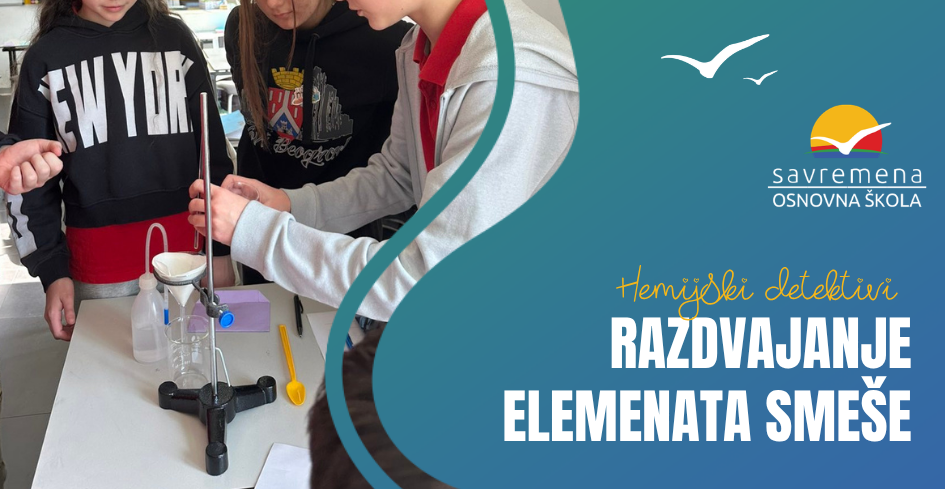
With magnifying glasses, beakers, filters, and carefully prepared mixtures in front of them, students received a task that sounds simple at first but requires precision, logic, and a scientific approach: separate the elements of the mixture. Each group received a different mixture — sand and salt, water and oil, fine metal and flour — and a set of tools they could use. But before they could begin, they had to stop and think: how will we do this? Which method will work for this specific combination of materials? What happens when we add water? When we use a magnet? When we filter or evaporate?
When Theory Becomes Experiment
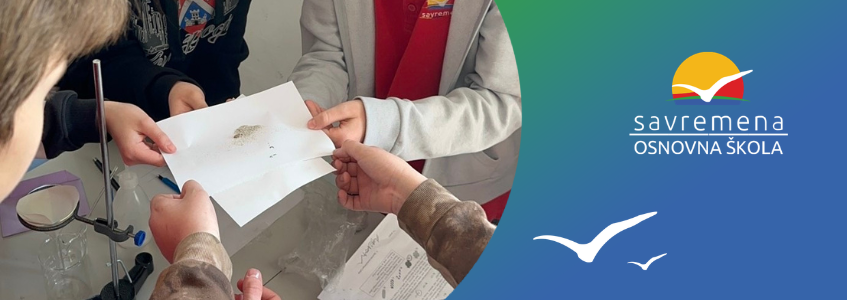
This wasn’t just an experiment. It was a process of scientific thinking. Students had to understand that each material has its own characteristics — density, solubility, magnetism, particle size — and that understanding those characteristics enables us to separate them. Sand doesn’t dissolve in water, but salt does. Metal reacts to a magnet, but flour doesn’t. Oil floats on water because it’s lighter. Each separation method — filtration, decantation, evaporation, magnetic separation — was a tool they had to choose wisely, just as a detective chooses which question to ask.
As they worked, the classroom was filled with quiet conversations, hypotheses, and occasional excitement when something succeeded. “Look, the sand stayed on the filter!” “The salt dissolved completely!” “The magnet only pulls out metal particles!” Each small success was confirmation that they understood the principle. Each mistake was an opportunity to stop, think, and try differently.
Science Isn’t Just a Formula — It’s a Way of Thinking
This experimental work wasn’t just about chemistry. It was about developing a scientific mind. About how to observe, how to hypothesize, how to test, how to draw conclusions. About how to be patient, precise, and analytical. These are skills that transcend chemistry — these are skills used in medicine, engineering, research, and even in everyday problem-solving.
Students learned that science isn’t just a set of formulas to memorize. Science is a way of thinking. It’s the ability to observe the world around you and ask “why?” and “how?”. It’s the ability to take what you know and apply it to what you don’t know. It’s the ability to be curious, precise, and persistent.
When students at the end of class looked at the separated elements of their mixture — sand on one side, salt on the other, clean water in a beaker, metal particles on a magnet — they saw more than a successful experiment. They saw proof that understanding principles enables control over material. They saw that knowledge is power. And they saw themselves as scientists capable of applying what they learn to the real world.
At Savremena, we don’t just teach children to know facts. We teach them to think like scientists, to question like researchers, and to solve problems like engineers. Because real chemistry isn’t just in formulas on the board — it’s in the hands holding the magnifying glass, in the eyes observing what’s happening, and in the mind understanding why.